
POST 3: This stage of the project is about precision. With the rough cuts and embroidery complete, it’s time to trim everything down to its final pattern dimensions.
This step serves two important purposes.
First, it allows the embroidery to be positioned intentionally. Now that the stitched elements are complete, I can place them exactly where they belong instead of hoping they landed well after construction. This is where the canopy really starts to look designed rather than assembled.
Second—and just as important—the embroidery changes the fabric itself. What began as a straight, clean edge along the selvedge is no longer straight. Dense embroidery pulls, curves, and subtly reshapes the fabric. Cutting final pattern pieces before embroidery would almost guarantee distortion later. Waiting until now keeps everything true.
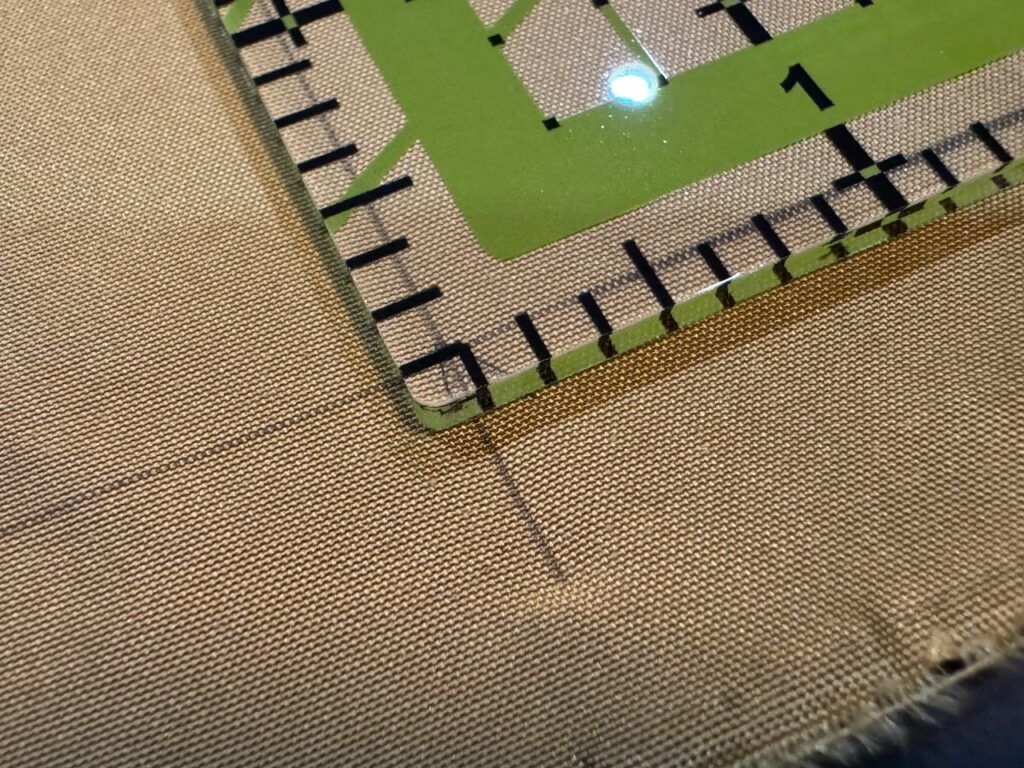
I’m not using a traditional paper pattern for this project. Every piece here is essentially a rectangle, and drafting, printing, and taping a pattern would take longer than simply drawing directly on the fabric – and I’m up against a deadline. Instead, I’m marking the dimensions directly on the fabric, then cutting.
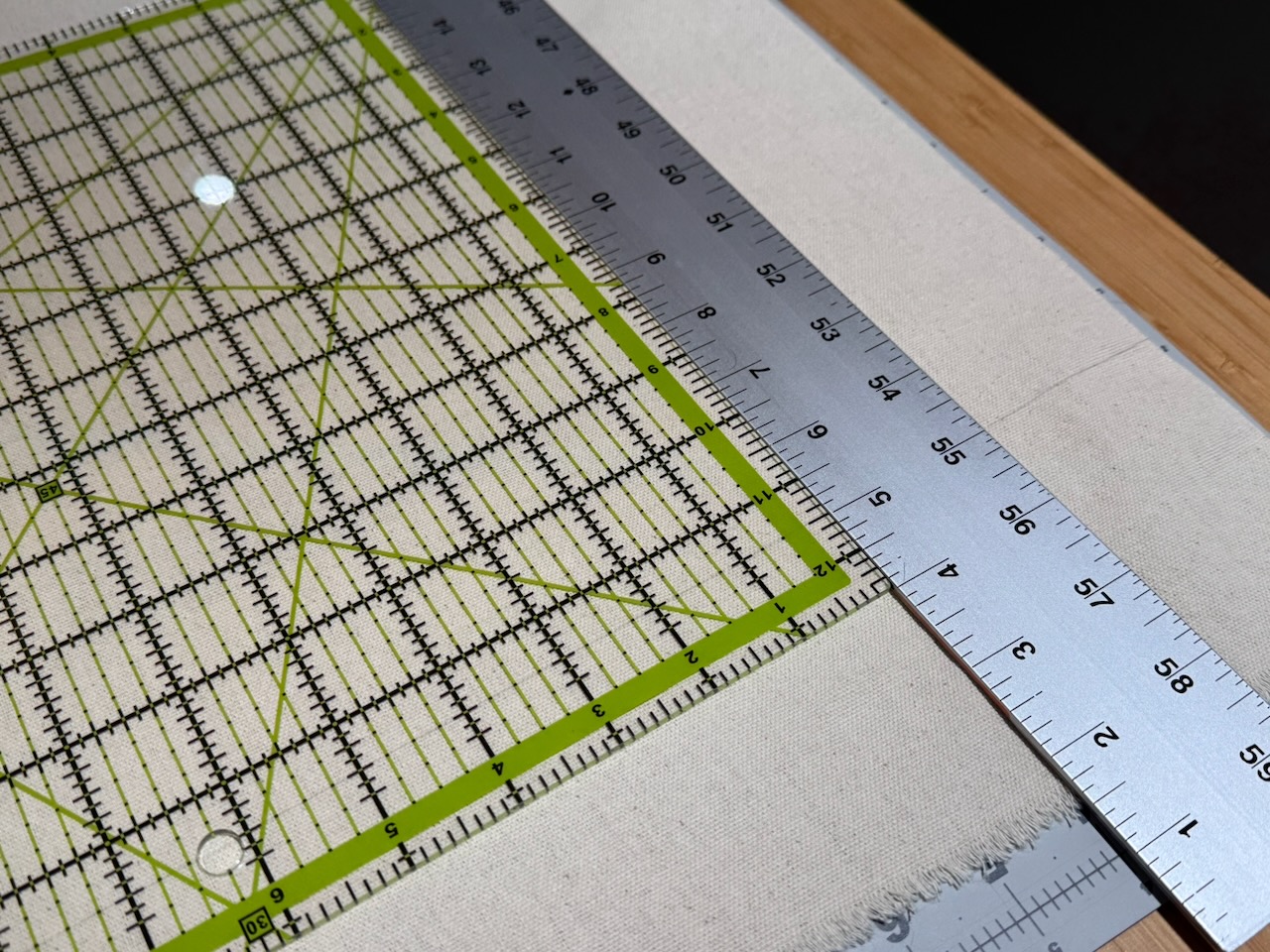
The biggest thing to watch at this stage is squaring everything up. Accuracy here affects every seam that follows. I draw all pattern lines first, then check every corner with a square ruler to make sure nothing drifts off angle. This is where the large square ruler really earns its keep.
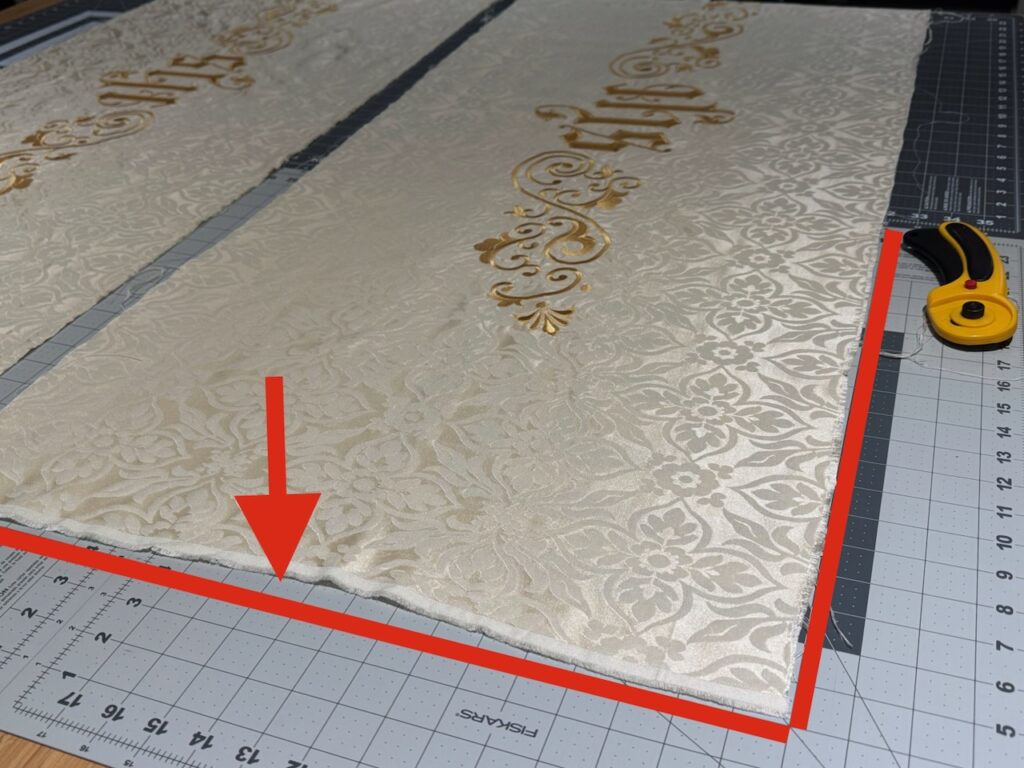
Measurements
The main top panel finishes at 52” x 70”. To that, I added 1¼” total in each direction to allow for ⅝” seam allowances.
The side flaps are:
- Two panels at 52” x 13” – to which 1-1/4″ is added to each side for seam allowances.
- Two panels at 70” x 13” – each created from two 35″ x 13″ panels that have 1-1/4″ added to each side for seam allowances and are stitched together to create the final panel size.
Once the lines were drawn and checked, I cut:
- The outer fabric, carefully accounting for embroidery placement
- The gold silk taffeta lining
- A layer of 7 oz cotton duck interlining, which will give the canopy structure and body without stiffness
At this point, everything is finally the size it’s meant to be—and square. From here on, construction can move forward knowing the foundation is solid.
This is quiet work, but it’s the kind that determines whether the finished canopy feels intentional, refined and truly glorifies God — or if it’s just good enough.
Leave a Reply