
My church celebrated 100 years this year. As part of the celebration, I decided to construct a Centenary Cope. For a centenary celebration, the vestment itself must carry memory, continuity, and restraint. This cope was never intended to be ornamental for its own sake. It needed to serve the liturgy, honor the clergy who had come before, and stand comfortably among a century of worship—without calling undue attention to itself.
That meant the work began long before any embroidery was stitched.
Fabric Selection as Foundation
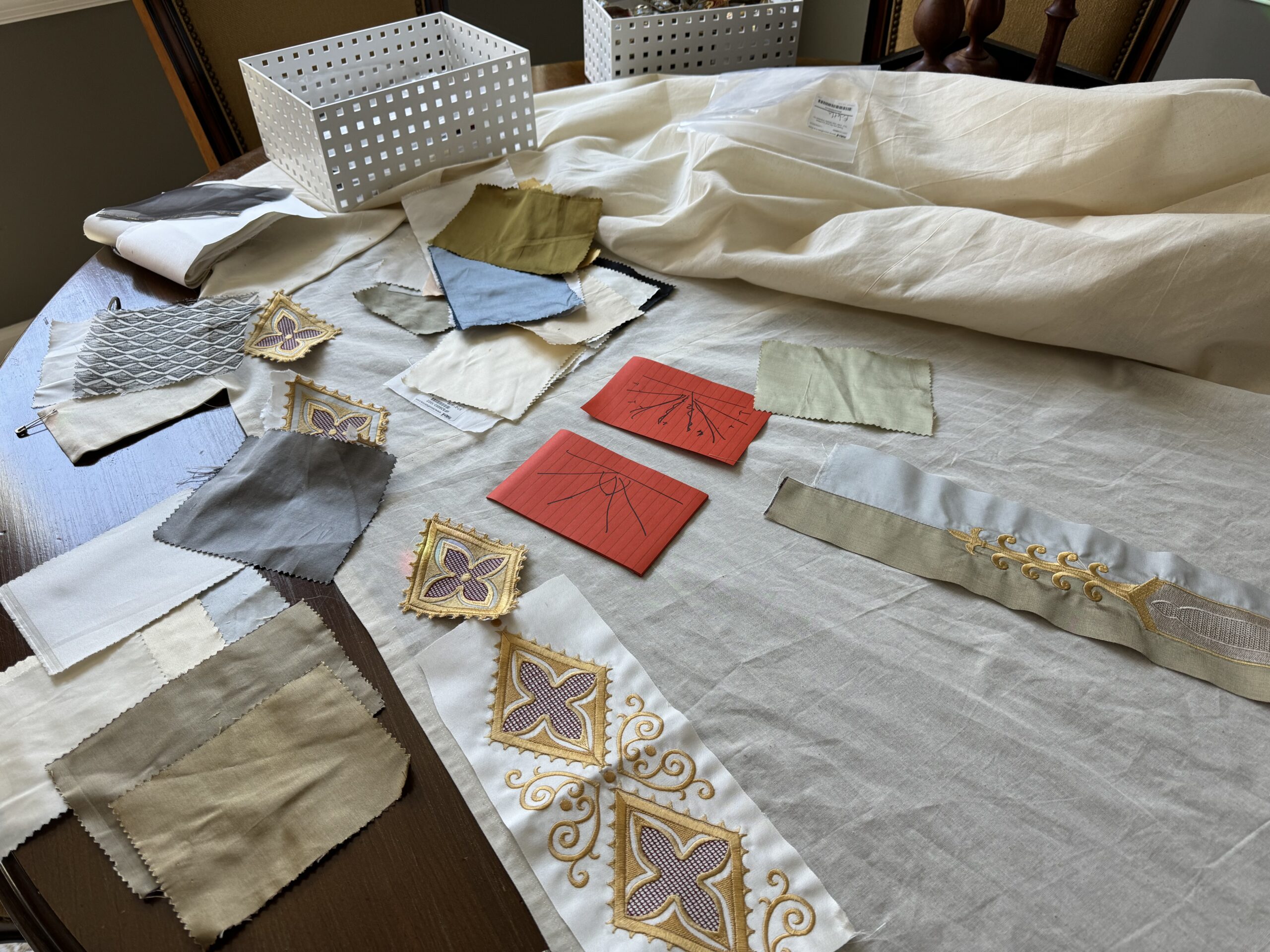
All of the main fabrics ultimately used for the cope were silks— silk taffeta and silk dupioni. This choice was deliberate. Silk provides a combination of body, luminosity, and longevity that is difficult to replicate with other fibers, particularly in a vestment intended to mark a centenary.
Both weaves were explored. Taffeta offered structure and clarity, while dupioni introduced subtle variation and depth through its natural slubs. Used together, they allowed for a restrained visual richness without relying on overt ornamentation.
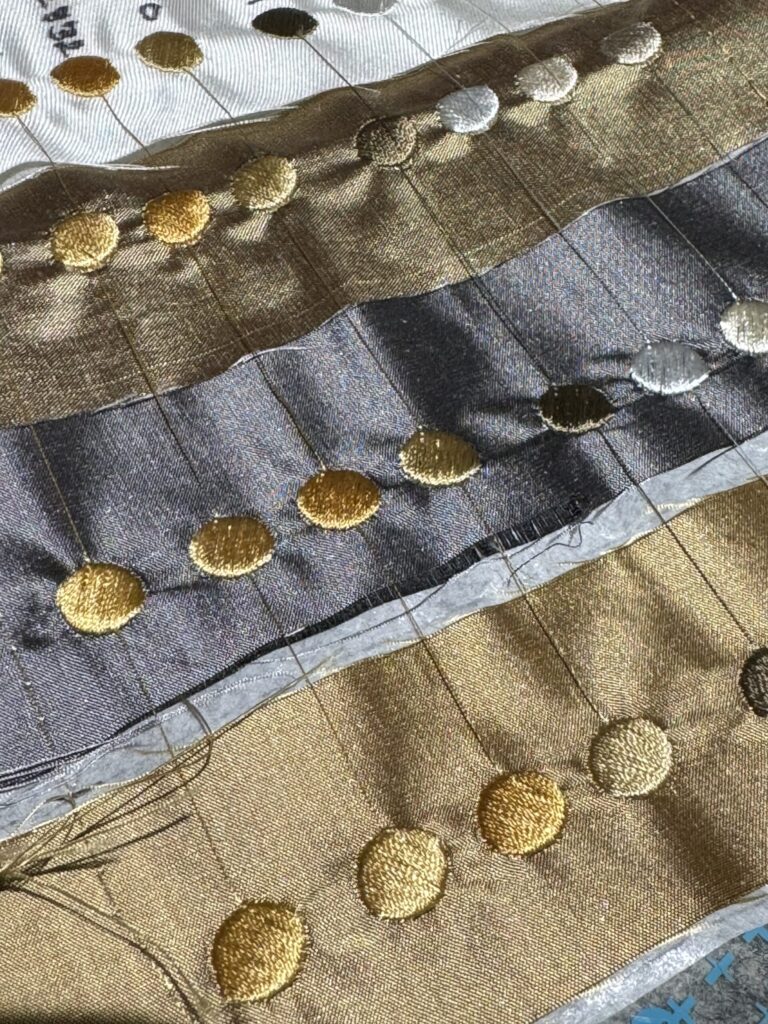
Because the design called for a gradual shift in color—from light silver through darker silver, into bronze, and finally gold—the interaction between weave, sheen, and embroidery had to be carefully considered. Silk responds to light differently depending on angle and movement, which meant that color transitions could be achieved quietly, through material choice rather than contrast alone.
The final selection balanced durability with sensitivity: fabrics capable of supporting dense embroidery while remaining supple in motion and dignified in use.
Pattern as Design, Not Just Structure
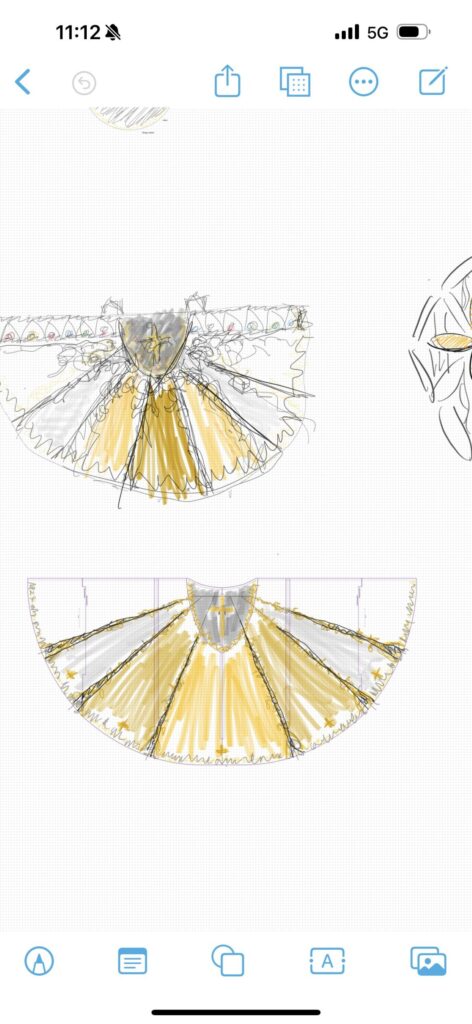
The pattern for this cope was driven as much by the design concept as by traditional construction. Rather than using a conventional half-circle or quarter-circle cope pattern, I chose to divide the cope into triangular panels.
This decision was intentional. From the beginning, I envisioned a gradual shift in color across the body of the cope—from light silver through darker silver tones, into bronze, and finally gold. Achieving that kind of controlled transition is difficult, if not impossible, on a single uninterrupted field of fabric without it reading as arbitrary or decorative.
By breaking the cope into triangular sections, the pattern itself became part of the visual language. The geometry allowed the color progression to unfold deliberately and symmetrically, giving the eye a sense of movement without distraction. Structure and surface design were developed together, each informing the other.
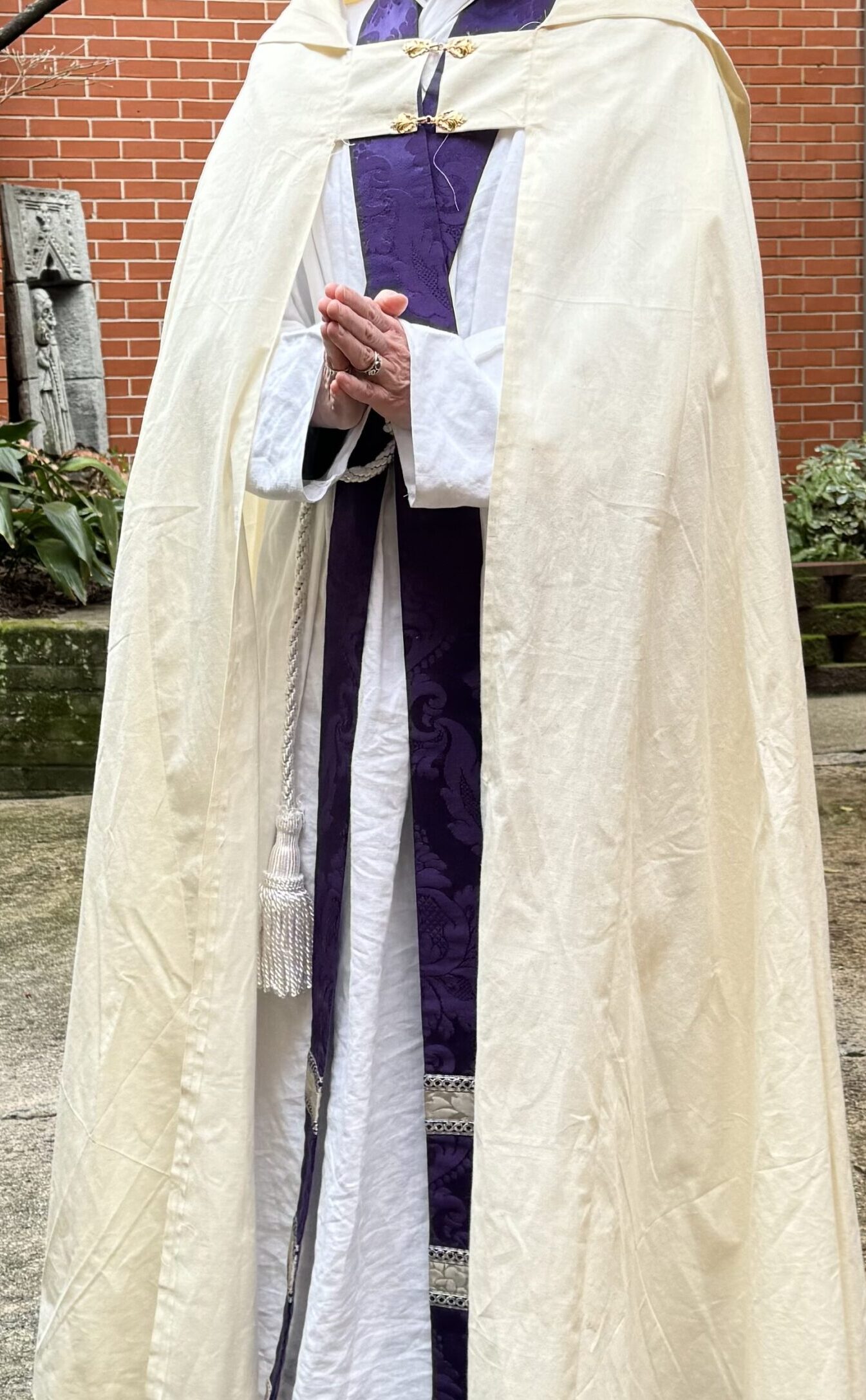
Creating a muslin of the pattern allowed me to test proportion, drape, and closure, and to make decisions about structure before committing any final materials. Subtle adjustments at this stage make the difference between a cope that simply fits and one that hangs with quiet authority.
A Deliberate Challenge: Machine Embroidery with Handwork Integrity
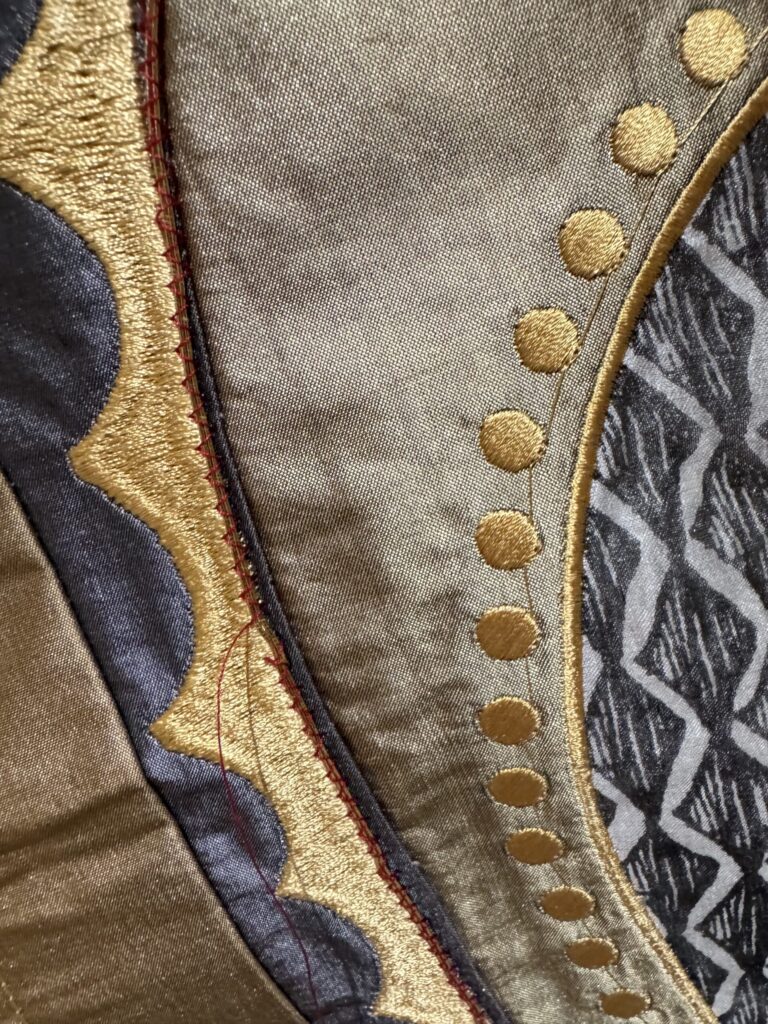
One of the central challenges I set for this project was intentional and specific: to develop machine embroidery that could stand alongside fine hand embroidery without apology.
This was not about speed or efficiency, although I knew I didnt have time for handwork at this scale. It was about control, density, layering, and finish. Machine embroidery can easily become flat, harsh, or overly regular if treated casually. To avoid that, I spent significant time developing designs and stitch structures that created depth, clarity, and softness—qualities traditionally associated with handwork.
Scale, stitch direction, edge treatment, and thread selection were all tested repeatedly. Some approaches were abandoned entirely. Others were refined until they achieved the balance I was seeking: embroidery that read as deliberate, dimensional, and appropriate to a sacred garment.
Experimentation and Technique Testing
Before any final motifs were determined, embroidery and assembly techniques were tested independently of the finished cope. This allowed decisions to be made without pressure—what worked visually, what distorted the fabric, and what would hold up over time.
This phase also ensured that later collaborative work, including parish involvement, would be supported by techniques that were simple and straightforward.
Why This Phase Matters
This early work is largely invisible in the finished vestment, but it governs everything that follows. Thoughtful design and testing reduce risk, clarify decisions, and create space for collaboration without compromise.
A centenary cope should feel settled and inevitable when it is finally worn. That sense begins here, in the slow and careful work of design—where materials, structure, and technique are brought into alignment.
Looking Ahead
In the next post, I’ll focus on the refinement of the embroidery motifs themselves—how symbolism, scale, and technique were balanced before the work moved beyond the studio and into the hands of the parish.